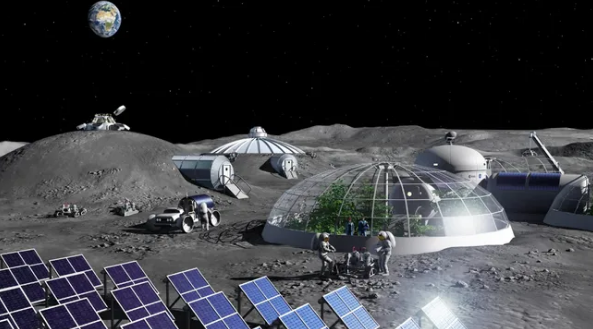
South Korea Unveils Bold Vision to Build Lunar Base by 2045
South Korea has revealed an ambitious plan to establish a permanent base on the moon by 2045, marking a significant step forward in the country’s growing space exploration program.
The roadmap, released on July 17 by the newly formed Korea Aerospace Administration (KASA), outlines a long-term strategy that includes robotic lunar missions, development of indigenous space technology, and infrastructure for sustainable lunar habitation.
As part of the plan, South Korea will develop its own lunar landers and rovers, as well as technologies capable of extracting vital resources—such as water ice—from the moon’s surface. These capabilities are seen as essential for enabling long-term human and robotic presence beyond Earth.
The roadmap includes several key milestones. A robotic lunar landing is targeted for 2032, followed by the deployment of a more advanced lander by 2040. These missions will serve as stepping stones toward the ultimate goal of constructing a functional lunar base by 2045—designed not only for scientific research but also for economic activities such as space mining.
In laying the groundwork for its lunar ambitions, South Korea has already achieved notable milestones. In August 2022, the Korea Pathfinder Lunar Orbiter (Danuri) successfully entered lunar orbit and continues to gather data about the moon’s surface. Additionally, prototype lunar rovers have been tested in abandoned coal mines to simulate conditions for future lunar mining missions.
South Korea just laid out its long-term space exploration road map, which features the planned construction of a moon base two decades from now. https://t.co/CQsmNyY7VO
— SPACE.com (@SPACEdotcom) July 20, 2025
KASA’s broader vision aligns with global trends in space exploration, where leading space agencies are now targeting the moon as a critical gateway for future space development. NASA’s Artemis program, China and Russia’s joint lunar initiative, and India’s plans to build a lunar base by 2047 all reflect the moon’s growing strategic importance.
South Korea is also setting its sights on Mars, with plans to achieve its first Mars landing by 2045—further underscoring its commitment to becoming a major player in space exploration.
“KASA’s mission is not just about reaching space, but about establishing a sustainable and innovative presence beyond Earth,” the agency stated. “Our goal is to contribute meaningfully to the global space community and open up new economic and scientific frontiers.”
As competition and collaboration intensify among spacefaring nations, South Korea’s lunar initiative highlights a growing recognition of the moon’s potential as a hub for international science, technology, and commerce.